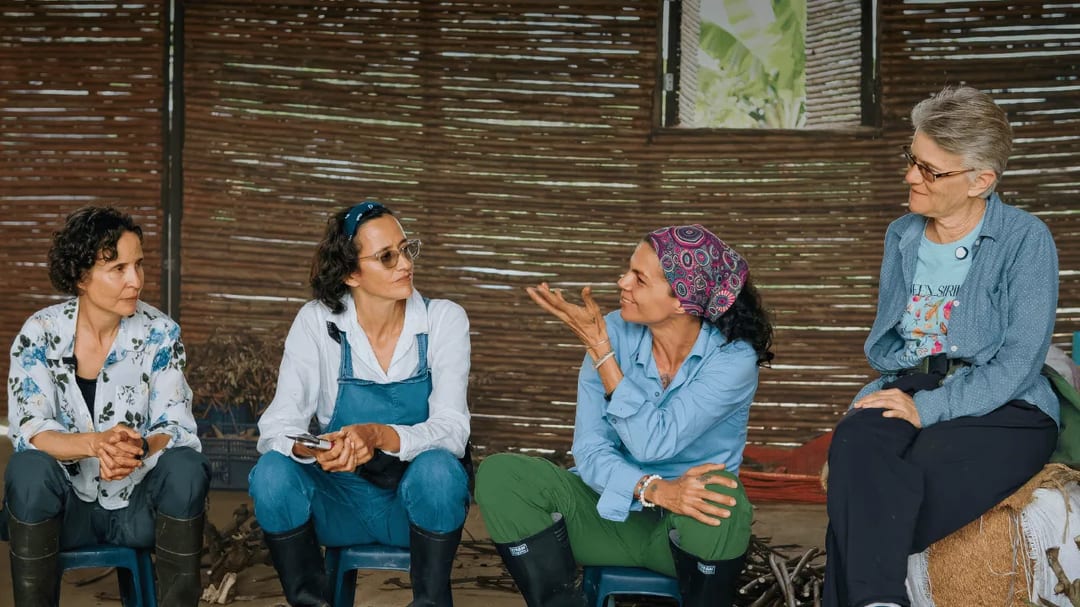
In Barichara, an inspiring collective of four women has taken a transformative step towards regenerating the territory through syntropic farming. The practice, which imitates the wisdom of forests, rests on cooperation and unconditional love for nature. In this article we look at how planting, restoring, sharing and learning together can become a path of personal and collective transformation, and how this philosophy reaches far beyond conventional agriculture.
A philosophy of love in syntropic farming
Syntropic farming is not merely an agricultural technique but a genuine philosophy of unconditional love and respect for nature. Its founding principle is to leave the territory better than we found it: to give rather than to extract. The practice is built on constant collaboration, expressed not only in the soil but in the human relationships within the collective.
Within that dynamic, every person and every plant finds a place and contributes something of its own. Just as in a forest, where each species complements and cooperates with the others to create a balanced ecosystem, in syntropic farming every element has a purpose and contributes to the common good.
Regenerating the territory through syntropic farming
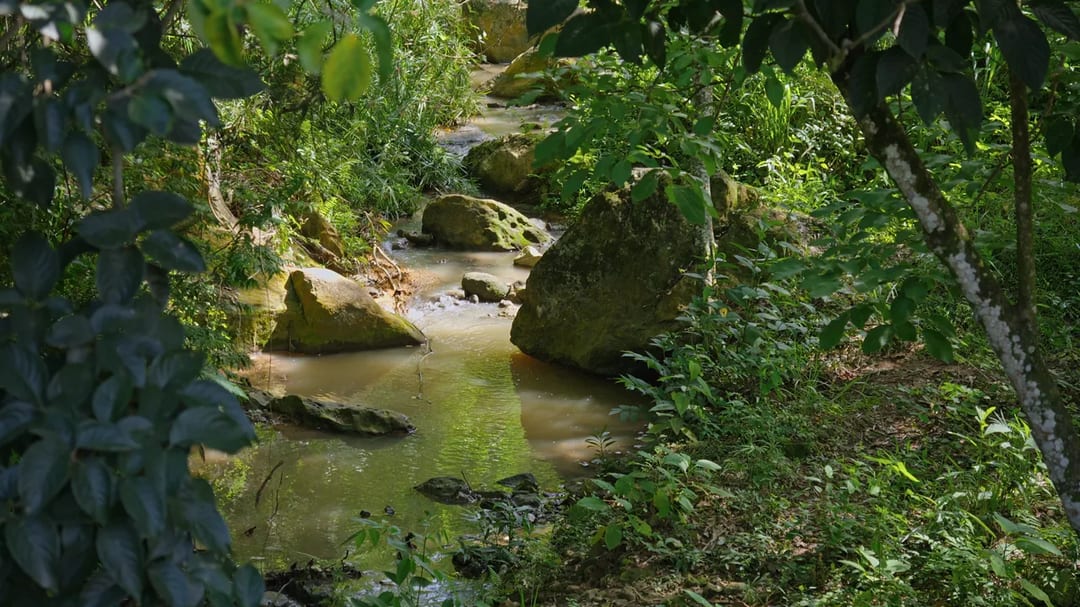
Faced with the degraded land of the Lubigará area, the collective decided to act with love and responsibility. Syntropic farming offered a solution that seeks not only to produce food but to improve the quality of the soil, recover water and reforest, particularly in areas damaged by earlier extractive practices.
The process demands patience and constant observation of natural cycles, learning to let go of the city’s accelerated rhythm and tune in to nature instead. It has been transformative for those who came from urban settings, or from traditional agricultural models built on continuous extraction without regeneration.
The essential role of women in syntropic farming
One striking feature of the collective is the persistence and dedication of the women in the syntropic farming process. Men and women took part at the outset, but it was the women who continued with greater constancy. This is attributed to the qualities farming requires: care, patience, and the capacity to understand and respect natural timescales.
The tasks that attract less male attention, pruning and weeding, are fundamental to the balance of the system. So the collective has consolidated as a largely female space, where each member contributes from her own style and strengths, complementing one another to reach remarkable results.
The wisdom of forests
Syntropic farming proposes a return to the natural cycles of earlier civilisations, in which there was no conflict between human development and the forest. Instead of extractive agriculture dependent on chemical inputs or imported materials, the aim is for the ecosystem itself to provide the resources needed to produce and to regenerate.
One essential practice is planting at high density and diversity, allowing plants to support one another. It is equally vital to keep the soil covered at all times: bare soil is like a wound in the earth: it compacts, and loses the life and the essential microorganisms it held.
Beyond that, observing and respecting every living thing, from the grasses to the ants, reveals how each fulfils functions the health of the system depends on. It is in that depth of attention that unconditional love for nature shows itself.
The challenge of spreading the model
One of the collective’s great challenges is broadening the practice, so syntropic farming becomes the norm in the region rather than the exception. They have worked to involve more campesino women and men who live from their produce and sell at local markets, in the hope that with practice and visible results other farms will take up the model.
That shift calls for patience and resilience, since full regeneration can take decades, though far less time than the centuries nature would need without human intervention. It also matters to dignify campesino work and to generate interest among younger generations, so they do not leave the countryside and the continuity of food production is not lost.
Education and gratitude: the keys to connecting with nature
Education is fundamental to reconnecting people, and young people above all, with nature and with the origin of the food they eat. Rather than imposing obligations, the collective works to awaken love and gratitude towards the land as a philosophy of life.
That genuine connection helps people value work in the countryside and understand that the relationship with nature must be one of respect and care. By opening your heart and falling in love with nature, you can receive far more than you expected, transforming not only the territory but your own life.
Frequently asked questions
It is an agricultural practice that imitates the natural processes of forests, built on cooperation, a high diversity of plants and a deep respect for nature, seeking to regenerate soil and ecosystem rather than merely extract resources.
Syntropic farming is a lifelong relationship with the land. Although full regeneration can take decades, visible results in the soil and in biodiversity can be observed within around 40 years, far sooner than natural processes without intervention.
No. The practice avoids chemical inputs, aiming instead for the ecosystem’s own natural resources to nourish and sustain agricultural production.
It is worth seeking out workshops, local groups or collectives working with syntropic farming. Education and learning together are fundamental to understanding and applying this philosophy.
Anyone interested in regenerative agriculture can practise it, but it requires patience, observation and commitment. In the Barichara collective, campesino women have been the main driving force, though they are also working to involve more people from the community.