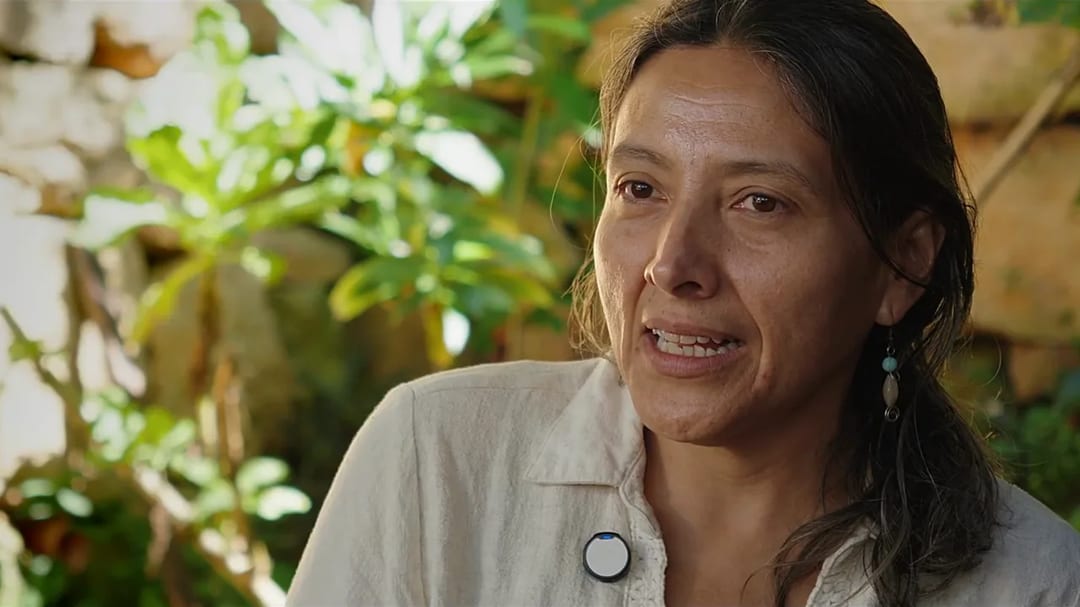
Casa Común is a living space in Barichara where growers, farmers, travellers, artists and neighbours meet to transform seasonal food, share knowledge and hold up a different kind of economy. It is a shop, a café and a laboratory, but above all it is an experiment built on an uncomfortable question: what would happen if we stopped taking for granted what we already have. Margarita Higuera, who arrived here at twenty-one, tells how it came about.
Drawn by the people, not the scenery
Margarita is a psychologist, and she came to Barichara to work in the countryside on a municipal primary-care programme. She travelled the whole territory, made friendships that have lasted, and stayed.
What kept her was not the architecture. “Beautiful houses aside, all of that aside, the loveliest thing about this place is its people.” She describes somewhere you greet someone and are greeted back, where an ancestral history seeps through the rammed-earth walls and the weaving, and where that density of connection produces something you cannot buy: a sense of safety, and of sovereignty.
She also talks about contagion. Many people arrive in Barichara wanting to change their lives, and that search stirs everyone else, the newcomers and those born here alike. “A contagion of really wanting to do things differently.”
Coming back as someone else
She spent a while away. When she returned, she came back as a mother rather than as a psychologist, and that changed how she saw the place. What did not change was a deep wish to give something.
Casa Común did not arrive as a plan. It began with building a house and, at the same time, with building a great many relationships: friends turning up, a house always open and available for whatever happened. In a financially hard stretch, with no clear way forward, what steadied her was starting to relate to the garden.
That relationship with the plants showed her the rest. “Starting to relate to the garden helped me understand and relate to the plants of this territory, to its people, to its processes.” That was when she saw the potential sitting in plain view in things nobody had assigned a value to.
The dermatologist nobody looks at
Margarita explains it with a tree. In the dry forest grows the indio desnudo, the gumbo-limbo, the best dermatologist in the territory, she says. Do we value it? No. Do we see it? No. Do we know it? No.
And from there she jumps to what actually interests her: “if that happens in nature, imagine: how could it not happen between people?” The other person brings enormous value, but we are so wrapped up in ourselves that we do not see it, and tend to start valuing it only when we need it.
Her reading of Casa Común is exactly that wager: valuing one another. How to recognise what someone else brings to this place, and what you bring yourself. It is an exercise almost nobody completes alone: you begin to see your own resources when someone else values them, when there is an exchange.
Nobody does this alone
Asked about the origin, she is blunt: as one person’s idea, Casa Común could never have taken this shape. It is the sum of many people who had spent a long time asking how to inhabit this territory, and this life, differently.
Nor is the main difficulty logistical. It is mental. The first thing, she says, was understanding that the person who had to change was her: shedding deeply lodged structures about economics, about security, about who she is and about what success means. When tension appears, the question she asks is what it is confronting inside her.
The second is harder still, because it does not depend on you: if dismantling your own structures is costly, pulling down the mental frameworks of a whole community (getting others to understand, getting everyone aligned on the purpose) cannot be forced. That, she says, has been among the hardest parts. And it is also what has obliged them to trust.
Life as an experiment
“Just as life is an experimental process, for me this is an experiment, like my life.” There is no certainty and nobody holds it: it is a mystery, and everyone is inside the same mystery. So the question is not whether something is right or wrong, but whether it is genuinely being tried.
The one thing she is certain of she states almost as a formula: if we learn to observe what we have and we value it, if we give it its place, abundance and sustainability arrive on their own.
Changing the world, or changing your own reality
Margarita declines the responsibility of changing the world (“who am I to change the world?”) and swaps it for something far smaller and far more demanding: changing her own reality, knowing that reality acts on everything around it. If everyone did that, she says, you would get what has been happening here.
In practice that has meant breaking the frameworks of who is in charge, who decides, whose idea it was, who coordinates, who has the bigger ego. Those are the forms that carry scarcity. The opposite, in a territory where “everything grows here,” is reciprocity: you cannot receive like that from a place without feeling responsible for it.
Casa Común does not call itself a success. The day Margarita says it is, will be the day everyone can relate to each other from trust and generosity rather than envy and scarcity. She knows it sounds utopian. But the scale she is testing it at is the small one, which is where these things either work or do not: a garden, an open house, and a community willing to do things differently.