In the hamlet of Lubigará lives Medarda Torres, one of the last people still making Guane pottery by hand, with clay from the ravine and stone from the mine. A group of children went to her house to learn the craft, and what they found was not a craft class: it was a chain of knowledge that has been travelling for generations and that now fits in a single pair of hands.

A craft handed down the line of grandmothers
Medarda started at around twelve. She did not choose it: at home everything was made of clay, and learning was simply what happened. “Everything at home was made that way, it was all clay. So that’s what I learned.”
Her mother taught her. Her mother learned from the grandparents, and they from the grandparents of the grandparents. Before aluminium and plastic arrived, the plates, the cups and the pots of the hamlet all came out of the ground, and the craft held up everyday country life.
Four days on the road to sell
That production did not stay at home. Medarda’s great-grandparents loaded the pieces onto mules and set out to sell them in Zapatoca and Galán, along the footpath, with no road. They left on a Thursday and came back on the Sunday or the Monday.
What sold best was the tejo, the clay griddle the arepa is baked on; in Medarda’s house it is still used every morning. And it did not always arrive intact: she was told that sometimes, close to the far markets, the pack came apart and the whole load was lost after three days of walking.
Clay does not come alone: it comes with stone
The first thing Medarda corrects, when someone assumes this is only a matter of kneading clay, is that it takes two things, not one: the clay and the stone.
The clay has to be fetched on foot. No vehicle and no mule can get there, because you have to cross a ravine and the path runs through cat’s-claw thorn that catches your clothes as you pass. You go down with sacks, load the bundle and carry it out to where an animal can reach. Then it is dried in the sun, crushed with a stone and put into water, because a large lump will not work.
The stone is a separate job. Medarda looks for quartz-bearing mine stone, heavy, and it has to be broken up, with a son-in-law helping her with the sledgehammer, and then ground down to powder. That powder is what gets mixed into the clay. Without it the piece will not survive the fire: “when you go to fire them they all crack, because clay can’t hold on its own.”
Treading the clay
With the ground stone on top, the clay is trodden. Barefoot, with your whole weight, until the mix is even and free of the lumps that later blow a piece apart. The children asked whether they could put their feet in. They could.
Medarda says it is healthy too. When a doctor asked whether her hands hurt and she said no, he wanted to know what she did for a living. She told him she worked clay. He told her it was very good for the body.
From a lump of clay to a pan
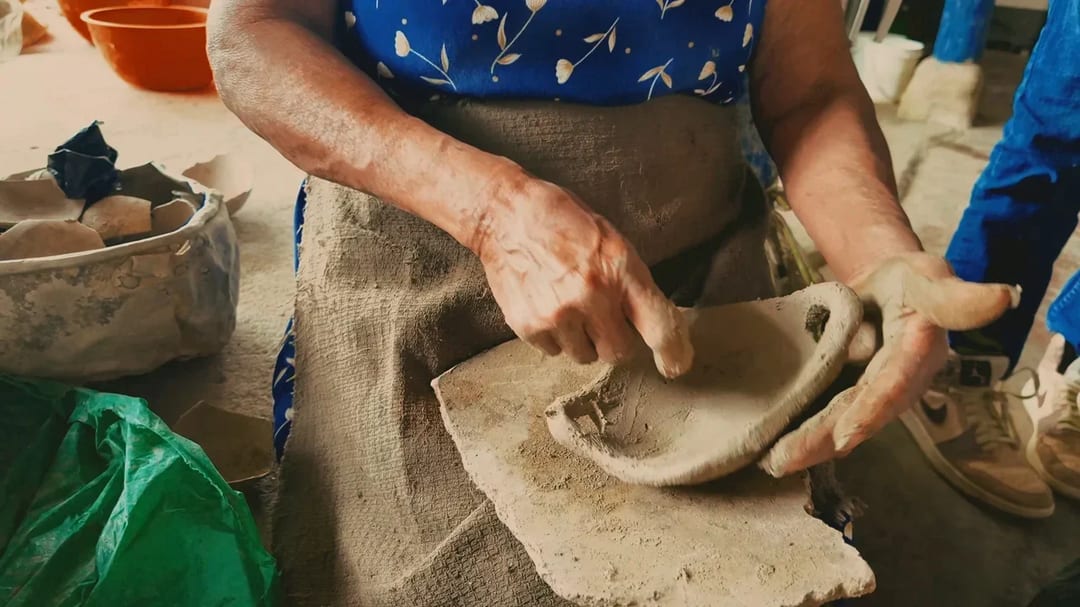
In the workshop, shaping a pan takes Medarda a few seconds: she raises the wall, closes it, adds a little handle, or two if you ask, and it is done. The children thought it was magic. Then she explained what those seconds hide: the next day you have to go back over the piece with a spoon, polish it, scrape the excess clay off the underside and smooth it, and only then can you start thinking about fire.
She also warned them what can go wrong. A freshly made piece can be found the next morning slumped and folded in on itself. Those are finished: they get gathered up, put back in water, and started again.
The fire, the wind and the stone
For the firing, Medarda stands the mine stone on edge, builds the firewood around it, and sets the griddles upright, wrapping them in more wood as she goes. The wood has to be dry; she keeps it covered with plastic, because water running through will split the pieces and ruin the whole batch.
Once it is lit, she says, it is not a matter of hours. She whistles until the wind arrives and the fire closes over the load. “I whistle up the wind.”
What comes out whole goes to market. What comes out cracked she does not sell: she leaves it lying about, and people take it home as an ornament.
“When I die, all of this ends”
There were once many hands doing this in the hamlet. Medarda names Dolores, Matilde, Constantino, Temilda, Vicente. All of them worked clay. “There’s no one left, no one left,” she says. And then the line that stops the conversation: “there’s no one else like me. When I die, all of this ends.”
She tried to pass it to her grandchildren. The walk to the clay made them dizzy and put them on the ground; only Raulín, the eldest, could manage: he had to carry the others’ loads out and then go back for them. None of them lives there now.
There was a period when she stopped altogether. After she was widowed, after Jesús, a long stretch passed in which she did not want to go on. It was a priest from Barichara who saw the vessels at the old house and asked that she be helped back to the craft, so that it might ease what she was carrying. And it did.
The door is still open
Medarda does not hoard what she knows. At the end of the afternoon she said so plainly: “anyone who wants to learn can come here. And I’ll teach them and I’ll tell them how, and that’s that.”
Crafts are not only work. They are memory and they are root, and they are among the few things that cannot be recovered once lost: when the last kiln goes cold, there is no manual left to copy them from. Which is why an afternoon of children with their hands in the clay, in a hamlet with no road up to the mine, is worth far more than it looks.